
This article contains affiliate links. We may earn a commission from qualifying purchases.
Some content on this site is AI-assisted and reviewed by our editorial team.
We earn a commission from qualifying purchases at no extra cost to you.
The first time I tried riding my bike with my dog, I held the leash in one hand and the handlebar in the other. That lasted about ninety seconds before she spotted a rabbit and nearly pulled me into a ditch. Lesson learned: if you want to ride with your dog, you need a real bike leash, not a death wish.
A dedicated dog bike leash keeps your hands on the bars and your dog at a safe distance. The good ones absorb the shock when your dog pulls or lunges, so a squirrel sighting does not become a crash. The bad ones are rigid metal bars that transfer your dog’s pulling force straight into your handlebars — avoid those.
I have spent enough time riding with dogs to know what works and what does not. Here are the three products I would actually trust, plus what to know before you clip in.

What Matters With Dog Bike Leashes
Safety is the whole game here. A dog bike leash has to do three things, and if it fails any of them, do not use it:
First, it keeps your hands on the handlebars. No holding a leash while steering — that is how people end up in the emergency room.
Second, it absorbs lateral force. When your dog pulls or lunges sideways, the arm should take the hit, not your bike. Spring-loaded arms or bungee designs do this. Rigid arms do not.
Third, it detaches quickly. If your dog stops suddenly or you go down, you need to separate from the leash fast. Quick-release mechanisms are non-negotiable.
Mounting matters too. Seat post mounts are easy to install and work with most bikes, but a big dog pulling on your seat post affects your balance. Axle mounts are more stable because the force hits lower, but they require swapping your skewer. Think about your dog’s size before choosing.
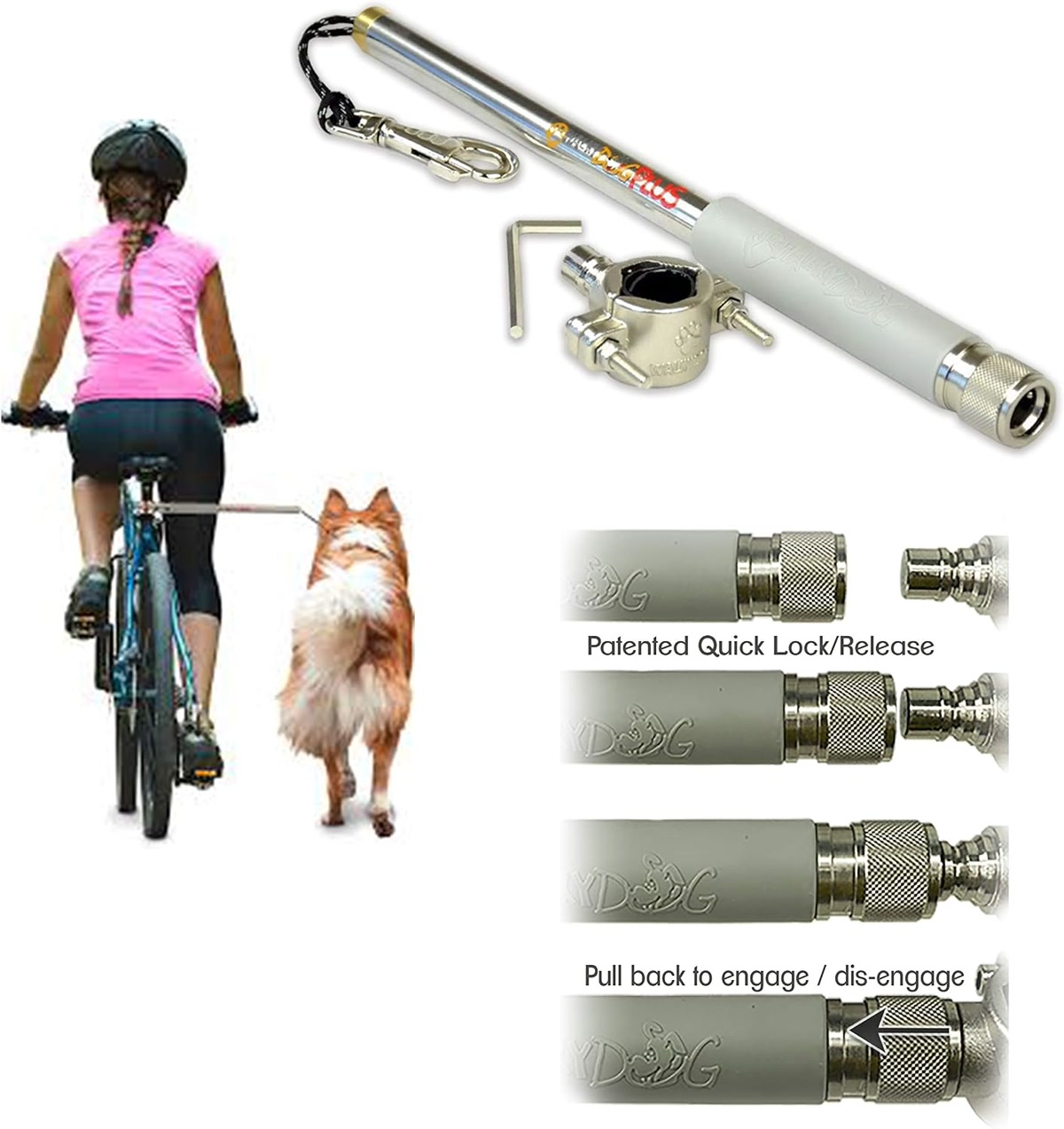
The One Most People Should Buy: WalkyDog Plus
The WalkyDog Plus is the default recommendation for a reason. It mounts to the seat post with a quick-release clamp, the arm has two internal springs that absorb lateral force, and it positions your dog at the right distance from the bike — far enough that they cannot run into the wheels, close enough that the leash is not a tripping hazard.
The springs handle a 60-pound dog pulling hard without yanking the bike sideways. I have used this with a 45-pound border collie who has strong opinions about squirrels, and the arm absorbed every lunge. The leash disconnects from the mount in seconds, so when you get where you are going, you clip on a regular leash and walk.
One thing to check: the universal mount fits seat posts from 25mm to 32mm. If your seat post is thicker, you need an adapter. The whole unit weighs under 2 pounds and you do not notice it when the dog is not attached.
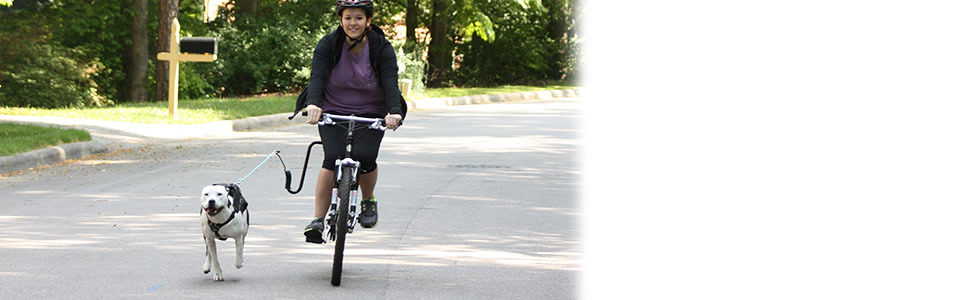
For Big, Strong Dogs: Springer Dog Exerciser
If your dog is 70-plus pounds and pulls like a freight train, the WalkyDog’s seat post mount may not be enough. The Springer mounts to your rear axle instead, which means the force hits lower and does not affect your balance the same way. The coil spring absorbs up to 350 pounds of pulling force — way more than the WalkyDog.
Installation is more involved. You have to swap your rear skewer for the included one, which takes a few minutes the first time. After that, the arm clips on and off in seconds. The axle mount is noticeably more stable with a big dog, and that stability is the whole point.
The safety break-away clip is a smart design. If your dog stops dead or gets spooked, the clip releases under extreme force instead of dragging your dog or pulling the bike over. The Springer also includes a second leash attachment for walking after your ride.
For Dogs That Cannot Run: Solvit HoundAbout II Trailer
Not every dog can run beside a bike. Small dogs, seniors, and flat-faced breeds like pugs and bulldogs do not have the legs or the airway for it. For those dogs, a trailer is the answer — and the HoundAbout II is the best value option.
The aluminum frame supports dogs up to 45 pounds. Inside is a padded floor, mesh ventilation on all sides, and an internal leash clip so your dog cannot jump out. The front door opens wide for loading. It attaches to your rear axle with a standard hitch and folds flat for storage.
What makes the HoundAbout II worth choosing over cheaper trailers is the stroller conversion kit. You ride to the park, detach the trailer, and convert it to a stroller for the rest of your walk. That versatility is genuinely useful if you want to bring your dog on longer outings without making them run the whole way.
The 20-inch wheels are fine on pavement and smooth dirt paths. Rough terrain will bounce your dog around — if you are hitting singletrack, look at the Burley Tail Wagon instead, but expect to pay more.
Riding Safely With Your Dog
The gear is only half the equation. How you ride matters just as much. Here is what I have learned the hard way:
- Train first. Walk your dog alongside your bike on a regular leash before you ever clip in a bike leash. Your dog needs to learn that the bike is not something to chase or bark at. A few sessions of walking next to the bike does wonders.
- Start in a parking lot. An empty parking lot is the best place for your first few rides. No traffic, no dogs, no squirrels. Let your dog get used to the speed and the sound of the bike before you hit the trail.
- Always use a harness. Attach the bike leash to a harness, never a collar. A sudden pull on a collar can injure your dog’s neck or throat. A good hiking harness works for this.
- Watch the temperature. Dogs overheat fast when they are running. Above 70 degrees, keep rides under 20 minutes and bring water. Above 80 degrees, leave the bike at home and go for a swim instead.
- Check the ground. Hot asphalt will burn paw pads. Stick to dirt trails, grass, or early morning pavement when surfaces are cool.
Which One Is Right for You
For most people, the WalkyDog Plus is the right pick. It is easy to install, it works with most bikes, and the shock absorption handles most dogs up to 60 pounds. If your dog is big and strong, the Springer is the safer choice because the axle mount handles more force. And if your dog cannot run alongside the bike, the HoundAbout II trailer lets them come along anyway.
Whatever you pick, pair it with a harness and start slow. The first ride with your dog is not the time to test your top speed. For more on safe outdoor adventures with your dog, check this guide to camping with a senior dog — a lot of the same safety thinking applies.
⛺ Get Your Free Camping with Your Dog Checklist
Join our newsletter and get this free printable plus weekly tips.
Price Check
Prices verified via our product tracker. Updated Sep 27.
| Amazon.com : WalkyDog Plus Dog Bicycle Leash for Bike : Pe | $69.99 | 4.4★ (4,355) |
| Amazon.com : Springer Hands-Free Dog Bike Leash Attachment | $82.79 | 4.1★ (639) |
As an Amazon Associate we earn from qualifying purchases.