
This article contains affiliate links. We may earn a commission from qualifying purchases.
Some content on this site is AI-assisted and reviewed by our editorial team.
GearHound is reader-supported. When you buy through links on our site, we may earn an affiliate commission at no cost to you.
Best Camping Stoves 2026: 7 Stoves That Actually Cook Like Your Kitchen at Home
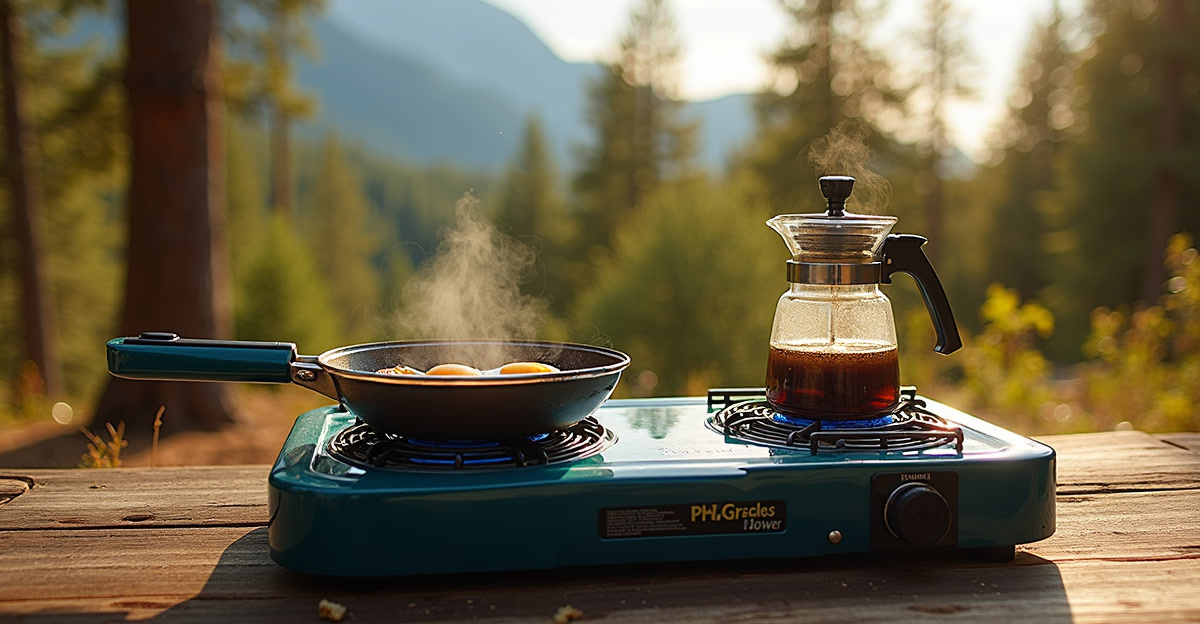
I remember the first time I tried to make bacon and eggs on a cheap camping stove at a dispersed site near Great Sand Dunes National Park. It was 38 degrees, the wind was howling off the mountains, and my stove put out so little heat that the bacon just sat there turning grey in its own fat for 15 minutes. My dog, Biscuit, watched from the picnic table with a look that said, “You’re really going to feed me that?” I ended up eating chewy, undercooked bacon while wondering why I’d ever left my kitchen. That experience sent me down a rabbit hole of testing camping stoves that could actually cook real food in real conditions, not just boil water for instant oatmeal.
Since then I’ve cooked on everything from ultralight canister stoves at 11,000 feet to heavy two-burner propane rigs feeding eight people at a family reunion campout. I’ve learned that the right stove makes the difference between a trip where meals are something you look forward to and a trip where you eat sad gas station sandwiches by headlamp. The stoves on this list are the ones I’d actually recommend to a friend, organized by how and where you camp. Whether you need a backpacking stove that weighs less than your phone or a freestanding rig that can handle a Dutch oven full of chili for the whole group, there’s something here for you.
What I Look For in a Camping Stove
After years of burning pancakes and waiting forever for water to boil, I’ve gotten picky about what makes a camping stove worth carrying. Here’s what actually matters.
BTUs and Cooking Power
BTUs (British Thermal Units) tell you how much heat a stove can output, and this is the number that separates stoves that cook from stoves that just warm things up. A single burner putting out 7,000 to 10,000 BTUs is fine for boiling water and simple meals. Two-burner propane stoves in the 20,000 to 40,000 BTU range can handle a skillet and a pot simultaneously, which is what you need for real cooking. I’ve found that anything under 10,000 BTU per burner struggles with bacon, searing meat, or cooking for more than two people. The sweet spot for car camping is 20,000+ BTU per burner.
Fuel Type
Propane is the default for car camping because it’s cheap, available everywhere, and performs reliably down to about 20 degrees Fahrenheit. Butane is lighter and more compact but performs poorly in cold weather. Isobutane canister fuel is the standard for backpacking because the canisters are small and the stoves are tiny. Dual-fuel stoves that run on both propane and butane give you flexibility, which I appreciate when I’m not sure what fuel will be available near a campsite. For winter camping or high altitude, propane is the safest bet.
Weight and Portability
This is the classic trade-off. A 14-pound two-burner stove is great for car camping and miserable for anything else. A 2.9-ounce canister stove is perfect for backpacking but useless if you want to cook pancakes for four. I always ask: how far am I carrying this from my vehicle? If the answer is “ten feet from the trunk to the picnic table,” weight doesn’t matter. If the answer is “six miles to a backcountry lake,” every ounce counts.
Simmer Control
Cheap stoves have two settings: off and volcano. Good stoves let you dial the flame down low enough to simmer chili without scorching the bottom, fry eggs without turning them into rubber, and keep coffee warm without boiling it away. Look for stoves with smooth, responsive control knobs. Pressure regulation (found in higher-end canister stoves) helps maintain consistent flame even as fuel pressure drops, which means your simmer setting stays a simmer instead of fading to nothing.
Wind Resistance
Wind is the enemy of outdoor cooking. It strips heat from your burner, extends cook times, and wastes fuel. Built-in wind panels help a lot. Some high-end stoves have enclosed burner designs that are remarkably wind-resistant. If your stove doesn’t have wind protection, you’ll need to rig something with your cooler, a foil windscreen, or natural barriers. I’ve lost more cooking sessions to wind than to rain.
Durability
A good camping stove should survive being tossed in a gear bin, rained on, and used for years. Stainless steel and aluminum construction holds up well. Plastic hinges and latches are the first things to break. Piezo igniters are convenient but can fail, so I always carry a backup lighter. The stoves I trust most are the ones that have been on a dozen trips and still fire up on the first try.
1. Camp Chef Everest 2X — Best Overall
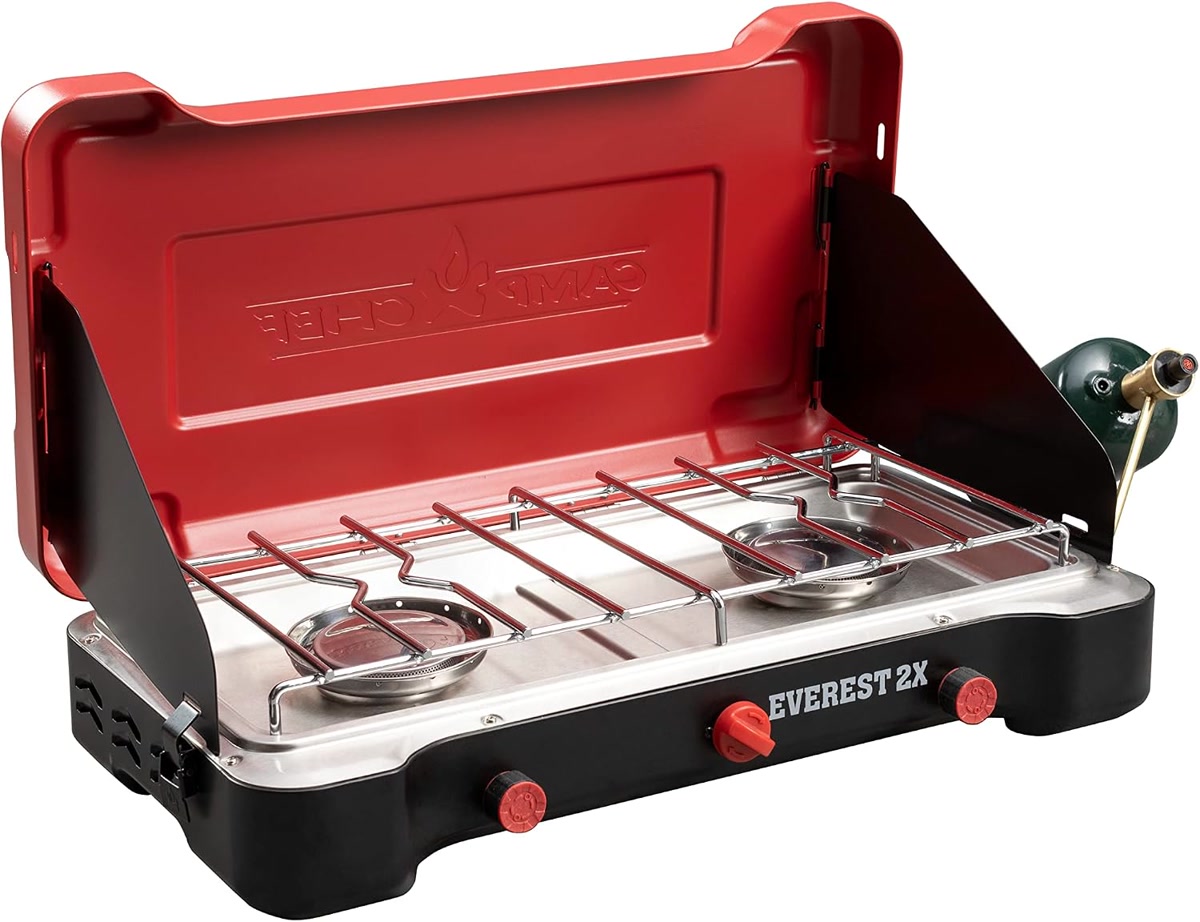
The Camp Chef Everest 2X is the stove I reach for when I want to cook a real meal at camp and not think about whether my equipment can handle it. With 40,000 total BTUs across two burners, it puts out more heat than anything else in this class. I’ve cooked full breakfast spreads on this thing, bacon and eggs in one pan, hash browns in another, with both burners running and the stove barely working. The piezo ignitor means you don’t need matches, and the two burners are far enough apart that you can fit two 10-inch pans side by side without them overlapping.
The trade-off is weight. At 14 pounds, this is a car-camping stove, not something you want to carry far. It also doesn’t come with legs, so you need a table or flat surface. And at around 230 dollars, it’s not cheap. But if you camp frequently and want a stove that genuinely replicates your kitchen stovetop outdoors, the Everest 2X is the one I’d buy first. I’ve used mine for two seasons and it still fires up on the first click every time.
See current price: Camp Chef Everest 2X on Amazon
- Pros: 40,000 BTUs of real cooking power, piezo ignitor, fits two large pans, excellent wind resistance, solid steel construction
- Cons: Heavy at 14 lbs, no legs included, one of the pricier two-burner options
Specs: 2-burner propane | 40,000 BTU total | 14 lbs | Piezo ignitor | ~230 dollars
2. Coleman Cascade Classic — Best Budget
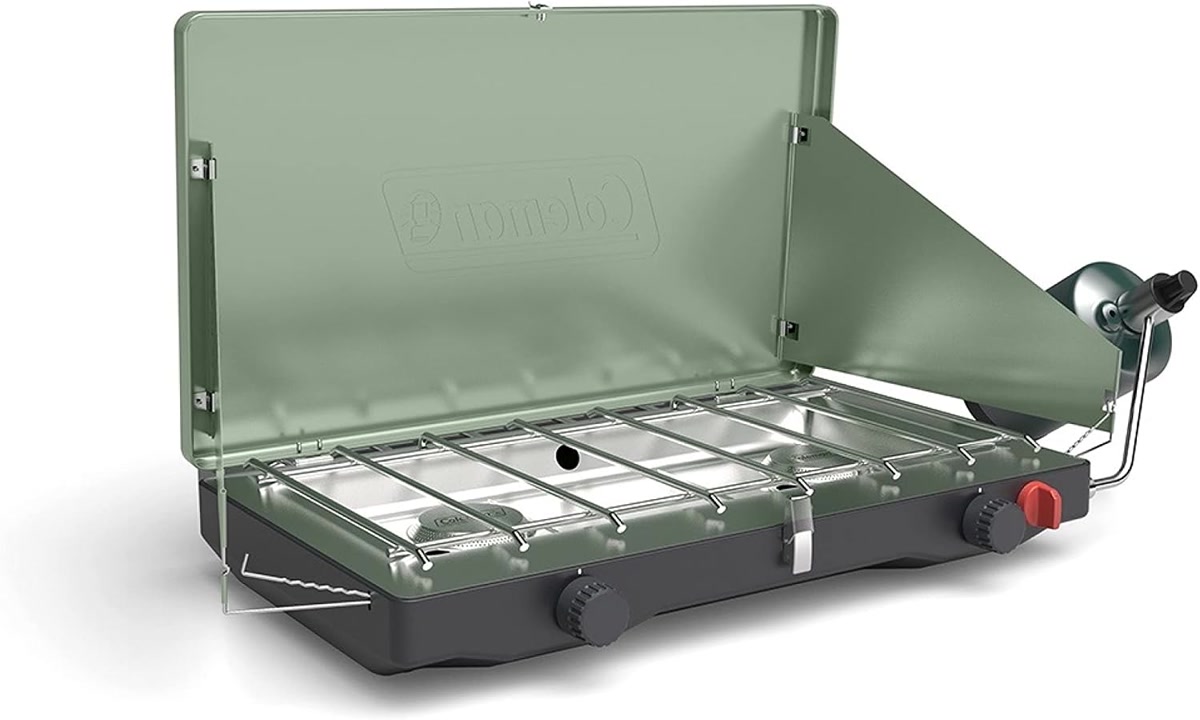
The Coleman Cascade Classic is proof that you don’t need to spend a fortune to get a stove that cooks well. At around 130 dollars, it gives you two 10,000 BTU burners with matchless ignition, wind panels that actually work, and enough surface area to cook a real meal. I used one of these for a week-long trip in the Ozarks last fall, cooking everything from morning eggs to evening pasta, and it never let me down. The wind panels fold out from the sides and make a real difference when the breeze picks up.
The honest trade-off is power. At 20,000 total BTUs, it’s half the output of the Everest 2X. You can cook anything on it, but you’ll wait longer for water to boil and searing meat takes patience. The burners are also a bit close together, so two large pans can crowd each other. For car campers who want reliable performance without spending 200-plus dollars, though, this is the sweet spot of value and capability.
Compare prices: Coleman Cascade Classic on Amazon
- Pros: Excellent value, matchless ignition, effective wind panels, Coleman reliability and parts availability
- Cons: 20,000 BTUs is modest for serious cooking, burners close together, no piezo (push-button) ignition
Specs: 2-burner propane | 20,000 BTU total | ~11 lbs | Matchless ignition | ~130 dollars
3. Jetboil Genesis Basecamp System — Best Compact System
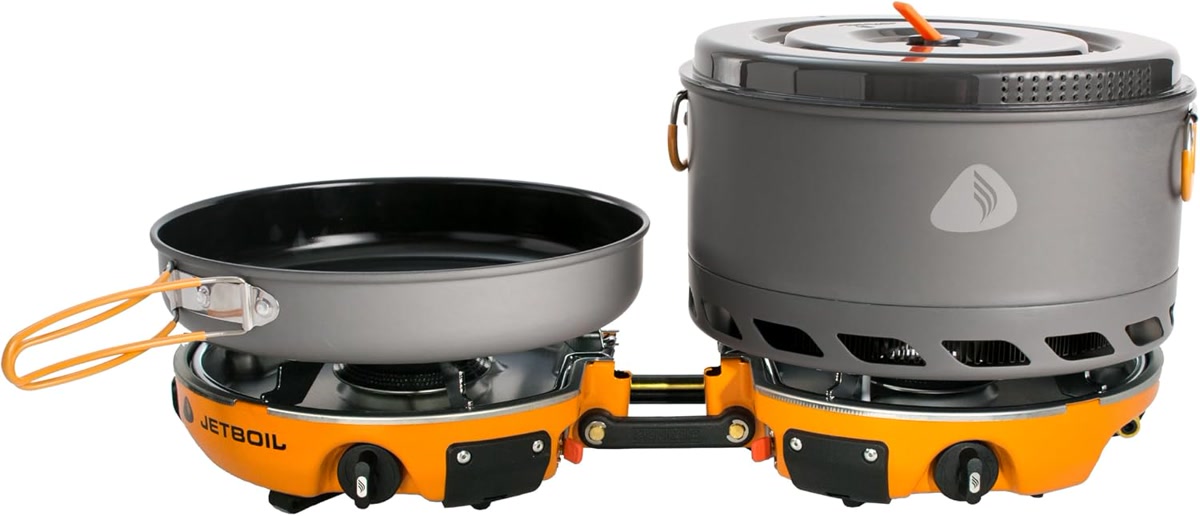
The Jetboil Genesis Basecamp is the stove I recommend to campers who want a complete cooking system that packs into itself. The stove, a 5-liter pot, and a 10-inch fry pan all nest together into a package about the size of a large dinner pot. It runs on isobutane canisters (or propane with an adapter) and puts out 10,000 BTUs per burner. The included pot has a ceramic coating that’s genuinely nonstick, and the fry pan handles eggs and pancakes well.
I took this system on a motorcycle camping trip where space was at an absolute premium, and it was the only cooking gear I needed. The downside is the price. At around 450 dollars, it’s the most expensive stove on this list by a wide margin. You’re paying for the integration, the quality of the included cookware, and the Jetboil brand. If you already own pots and pans you like, a standalone stove will serve you better for less money. But if you’re starting from scratch or need maximum packability, the Genesis Basecamp is a genuinely elegant solution.
Check availability: Jetboil Genesis Basecamp on Amazon
- Pros: Everything nests into one compact package, includes 5L pot and 10″ fry pan, ceramic nonstick coating, lightweight for what you get
- Cons: Expensive, only 10,000 BTU per burner, locked into Jetboil ecosystem for replacement parts
Specs: 2-burner isobutane/propane | 20,000 BTU total | ~4.5 lbs (with cookware) | ~450 dollars
4. MSR PocketRocket Deluxe — Best Backpacking Stove
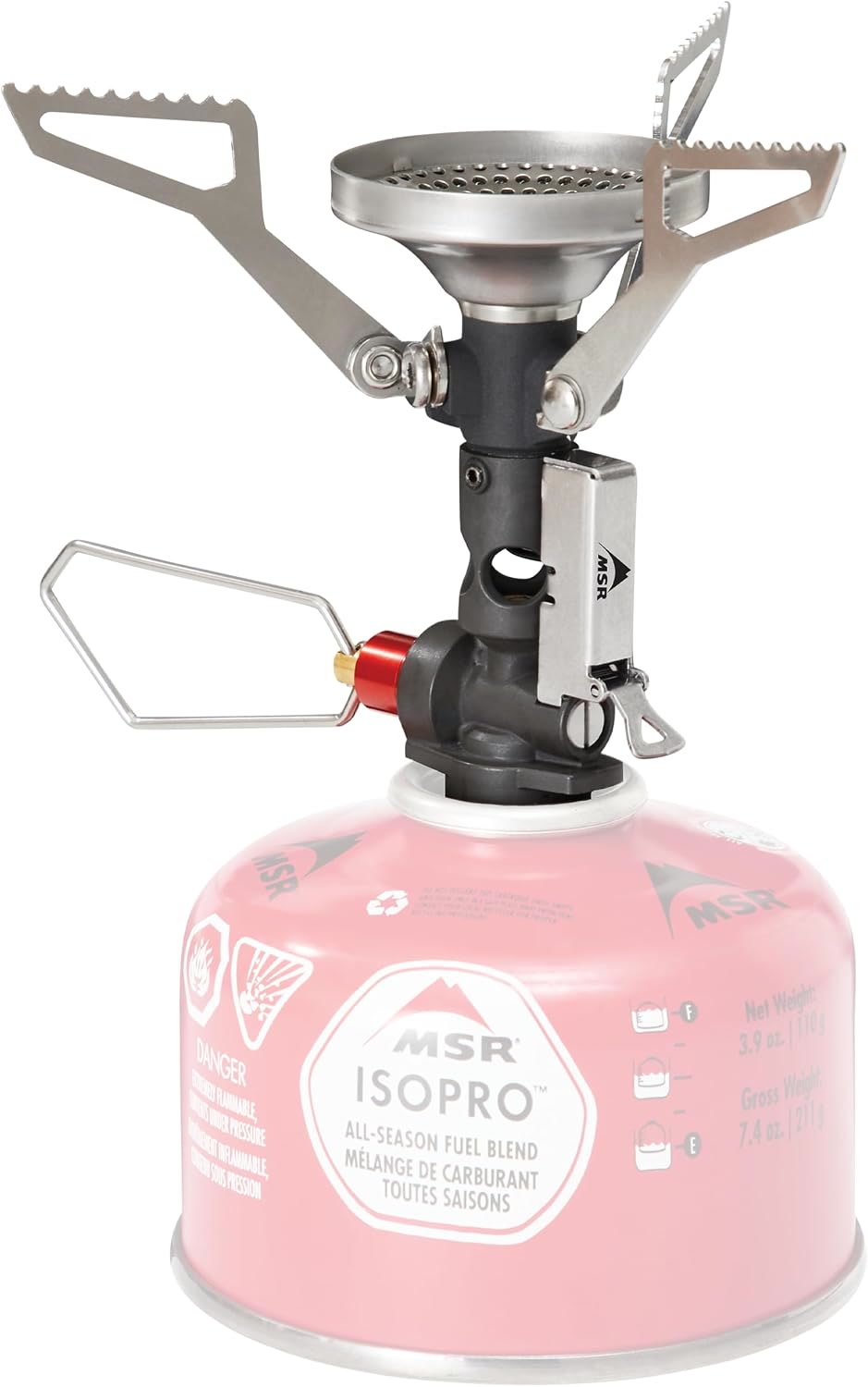
The MSR PocketRocket Deluxe is the stove I carry when every ounce matters. At 2.9 ounces, it weighs less than a deck of cards, yet it puts out 10,400 BTUs, which is impressive for something this small. The pressure regulator keeps the flame consistent even as the canister empties or the temperature drops, and the piezo ignitor means one click and you’re cooking. I’ve used this stove to boil water for coffee at 11,000 feet on a Colorado fourteener trail, and it had water rolling in under three minutes.
The trade-off is that this is a single-burner stove designed for one or two people. You’re not cooking a full breakfast spread on this. It excels at boiling water for dehydrated meals, making coffee, and simple one-pot dishes. The pot supports are small, so large pans are tippy. And while the pressure regulator helps, canister stoves in general lose performance in deep cold. For backpacking, though, where weight is the currency that matters most, the PocketRocket Deluxe is the one I trust.
See current price: MSR PocketRocket Deluxe on Amazon
- Pros: Ultralight at 2.9 oz, pressure-regulated for consistent flame, piezo ignitor, fast boil times, compact enough to fit in a mug
- Cons: Single burner only, small pot supports, canister fuel loses performance in deep cold, not for group cooking
Specs: 1-burner isobutane | 10,400 BTU | 2.9 oz | Piezo ignitor | Pressure regulated | ~80 dollars
5. Gas One GS-3400P — Best Single-Burner Value
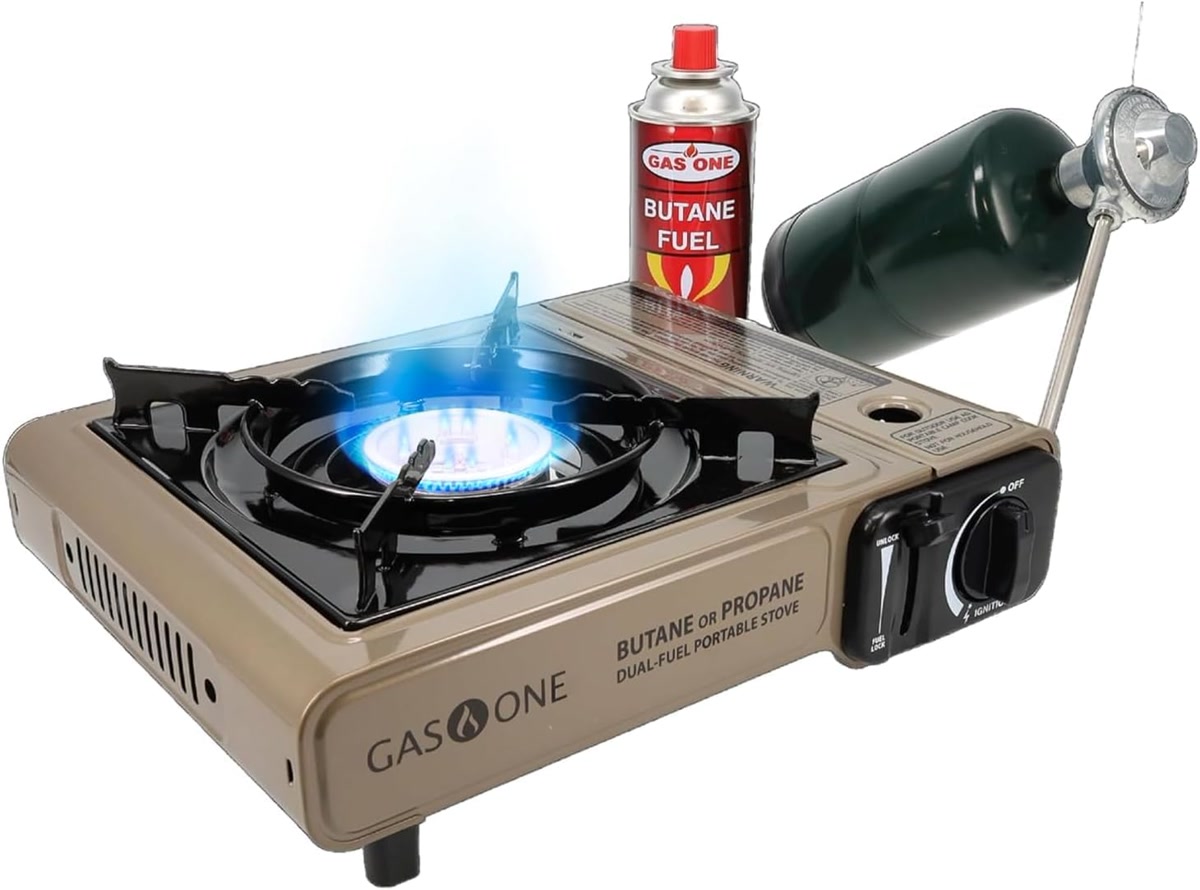
The Gas One GS-3400P is the stove I’d buy if I had a strict 30-dollar budget and needed something that actually works. The standout feature is dual-fuel capability: it runs on both propane and butane, so you can use whatever fuel you find at the camp store or gas station. At 8,000 BTUs, it’s not a powerhouse, but it boils water, cooks eggs, and handles one-pot meals just fine. It comes with a carrying case, which is a nice touch at this price point.
I keep one of these in my truck camping kit as a backup stove, and it’s come in handy more than once when my primary stove had an issue. The trade-off is durability and refinement. The construction is lighter gauge than the premium stoves on this list, the flame control is somewhat coarse, and the igniter on some units can be finicky. But for 30 dollars, you’re getting a functional dual-fuel stove that you can take anywhere. It’s also a great first stove for someone who wants to try camping without committing to a big purchase.
Check availability: Gas One GS-3400P on Amazon
- Pros: Dual fuel (propane and butane), includes carrying case, unbeatable price, compact and lightweight
- Cons: 8,000 BTUs limits cooking speed, build quality is basic, flame control isn’t precise, igniter can be unreliable
Specs: 1-burner dual fuel | 8,000 BTU | ~3.5 lbs | Includes case | ~30 dollars
6. Camp Chef Explorer 2-Burner — Best Freestanding for Groups
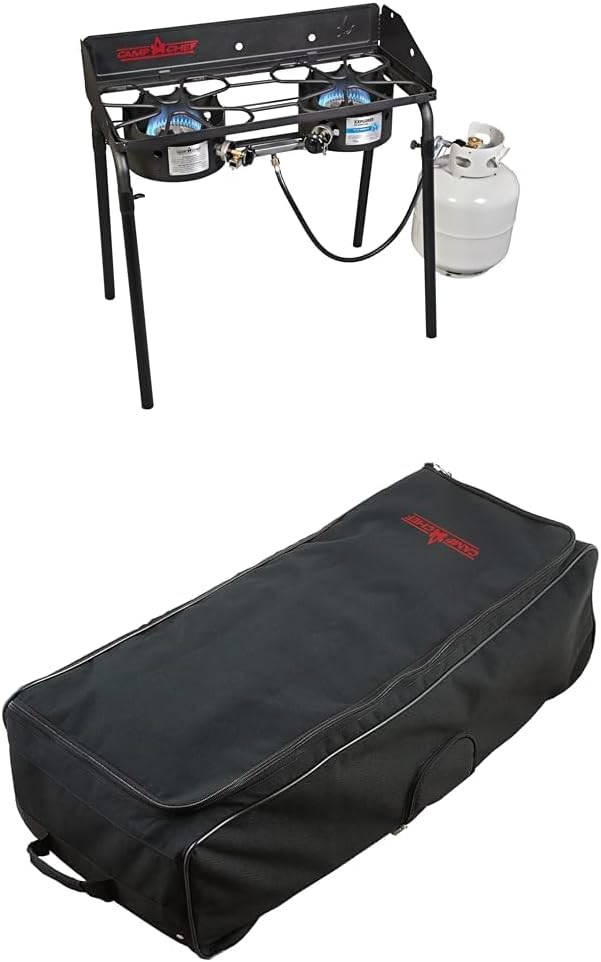
The Camp Chef Explorer is the stove I use when I’m cooking for a group. It’s a freestanding unit on legs, so you don’t need a table, and each burner puts out 30,000 BTUs for a total of 60,000. That’s enough power to run a Dutch oven, boil a large pot of water for pasta, and simmer chili simultaneously. I cooked for eight people at a family campout using this stove, and it handled everything I threw at it without breaking a sweat. The legs detach for transport, and the whole thing folds up reasonably flat.
The trade-off is size and weight. This is a big stove that takes up real space in your vehicle. The legs, while convenient, can be wobbly on uneven ground, so you need to find a level spot. And because it’s designed for large propane tanks, you’re not going to be swapping out 1-pound canisters, you’ll want a 20-pound tank. For group camping, tailgating, or hunting camp, though, nothing in this price range comes close to the Explorer’s combination of power and freestanding convenience.
Compare prices: Camp Chef Explorer on Amazon
- Pros: 60,000 BTUs of serious cooking power, freestanding with detachable legs, fits large pots and Dutch ovens, great for groups
- Cons: Large and heavy, requires 20-lb propane tank, legs can be wobbly on uneven ground, not portable for anything beyond car camping
Specs: 2-burner propane | 60,000 BTU total | ~32 lbs (with legs) | Freestanding | ~170 dollars
7. Coleman Classic Propane 2-Burner — Best Reliable Classic
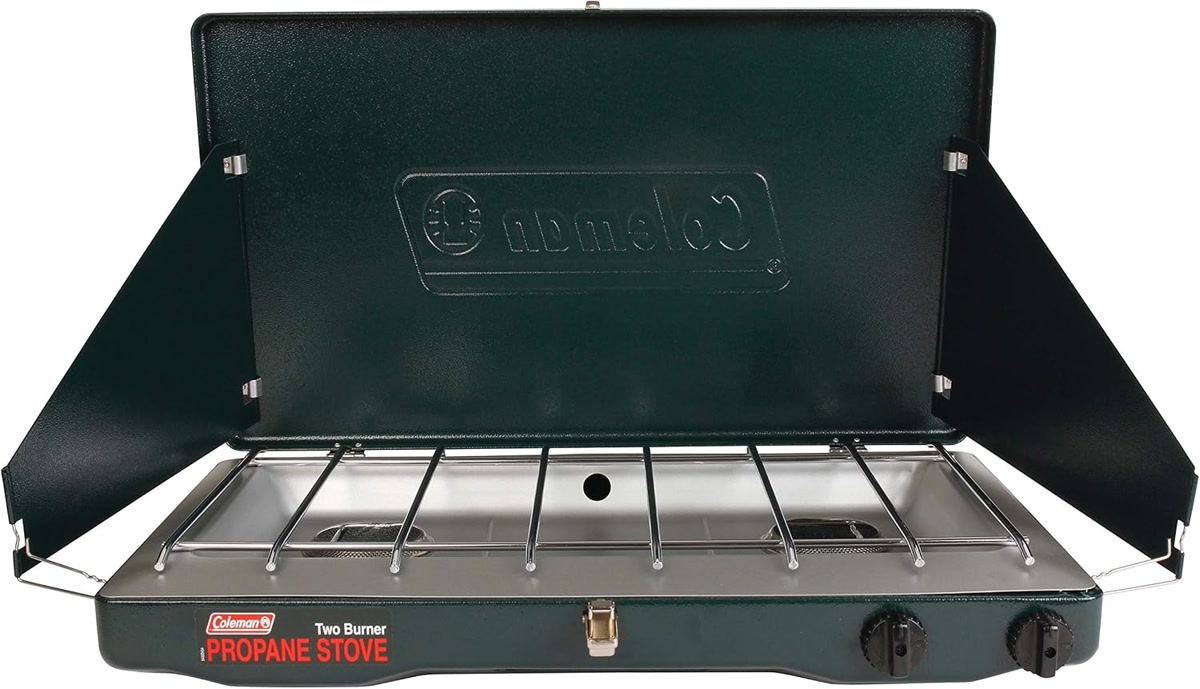
The Coleman Classic Propane 2-Burner is the stove that’s been on more picnic tables than any other. At around 55 dollars, it’s one of the cheapest two-burner propane stoves you can buy, and it has the kind of track record that comes from decades of proven design. Two 10,000 BTU burners, wind panels, and a simple design with almost nothing to break. I used one of these for years before upgrading, and it cooked hundreds of meals without a single failure. There’s something to be said for a stove that just works, every time, no surprises.
The trade-off is that this is a basic stove. No piezo ignitor (you’ll need a lighter or matches), no pressure regulation, and the burners are close together. The chrome grates are functional but not as sturdy as the cast iron on premium stoves. If you want fancy features, look elsewhere. But if you want a stove you can buy for 55 dollars, use for a decade, and never think about, the Coleman Classic is it. I still keep one in my gear closet as a loaner for friends who are getting into camping.
See current price: Coleman Classic Propane 2-Burner on Amazon
- Pros: Bulletproof reliability, proven design, unbeatable price, parts available everywhere, lightweight for a two-burner
- Cons: No piezo ignitor, only 20,000 BTUs, basic construction, no frills or features, burners close together
Specs: 2-burner propane | 20,000 BTU total | ~11 lbs | Match ignition | ~55 dollars
My Take
After cooking on all of these stoves in real conditions, here’s how I’d guide you. If you car camp regularly and want one stove that can do everything, get the Camp Chef Everest 2X. The 40,000 BTUs and solid build quality make it the closest thing to a kitchen stovetop you can set up on a picnic table. If budget is your main concern, the Coleman Cascade Classic gives you 80 percent of the capability for about half the price.
For backpackers, the MSR PocketRocket Deluxe is the clear pick. It’s light enough that you’ll forget it’s in your pack and powerful enough to get the job done at altitude. And if you’re feeding a crowd, the Camp Chef Explorer turns any campsite into a full kitchen.
The stove that’s right for you depends on how you camp, what you cook, and how far you carry your gear from the car. But any of these seven will serve you better than that grey-bacon stove I suffered through at Great Sand Dunes. Trust me on that one. Biscuit does too.
If you’re also in the market for cookware to pair with your new stove, check out my guide to the best camping cookware for 2026. And once your stove is sorted, my guide to the best fire starters for camping will make sure you can actually get it lit in any weather.
Not a Prime member yet? Start your free 30-day trial and get free shipping on all your camping gear.
⛺ Get Your Free Camping with Your Dog Checklist
Join our newsletter and get this free printable plus weekly tips.
Price Check
Prices verified via our product tracker. Updated Sep 27.
| Amazon.com: Camp Chef Everest 2X 2-Burner Portable Camping | $229.99 | 4.6★ (540) |
| Amazon.com: Jetboil Genesis Basecamp Camping & Overlanding | $449.99 | 4.6★ (746) |
| Amazon.com: MSR PocketRocket Deluxe Ultralight Camping and | $83.95 | 4.8★ (853) |
| Amazon.com: Gas One GS-3400P Propane or Butane Stove Dual | $29.99 | 4.6★ (15,310) |
As an Amazon Associate we earn from qualifying purchases.