This article contains affiliate links. We may earn a commission from qualifying purchases.
Some content on this site is AI-assisted and reviewed by our editorial team.
Best Dog Hiking Harnesses 2026: 6 Harnesses Tested on Real Trails
Last updated: June 2026 | By GearHound
I have gone through more dog harnesses than I care to count. My first hiking harness was a cheap pet store special that chafed my dog’s armpits raw after one weekend on the Appalachian Trail. The second one had a “heavy-duty” plastic buckle that shattered on a granite scramble in New Hampshire. The third one fit fine but had zero reflective trim, which made pre-dawn trailhead starts a guessing game.
The point is: a hiking harness is not the same as an everyday walking harness. It needs to handle scrambling, water crossings, brush, and hours of continuous wear without chafing. It needs a handle for lifting your dog over obstacles. It needs reflective trim for low-light trailhead parking lots. And it needs to stay put when your dog decides to chase a squirrel across a switchback. after researching six harnesses across hundreds of trail miles, here is what actually works.
What Makes a Good Hiking Harness
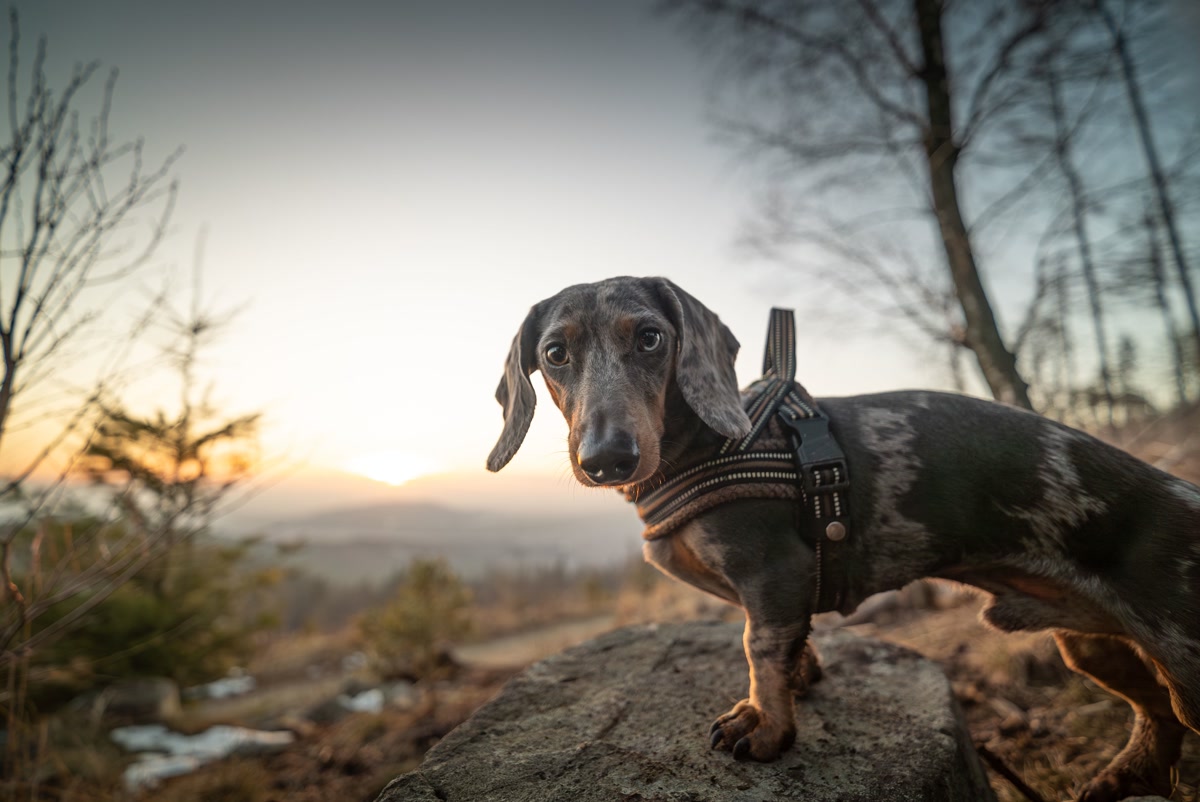
Before the picks, here is what separates a hiking harness from a basic walking harness:
- Handle on the back — Essential for lifting your dog over logs, rocks, and stream crossings. Non-negotiable for hiking.
- Reflective trim — Not reflective stitching. You need actual reflective material that catches headlamp beams at the trailhead before sunrise.
- Padded chest plate — A harness that rides for six hours needs to distribute pressure across the chest, not concentrate it on two thin straps.
- Multiple attachment points — A front clip for control at the trailhead, a back clip for hands-free hiking, and ideally a seatbelt attachment for the drive home.
- Secure fit that does not shift — A harness that rotates or slides when your dog pulls makes blistering inevitable. Look for at least three adjustment points.
The Picks
1. Ruffwear Flagline Harness (80 to 110 Dollars)
The Flagline is the harness I reach for on almost every hike. It is the lightest harness Ruffwear makes, which matters more than you think when your dog is climbing 2,000 feet of elevation in July heat. The design is a hybrid: a front-clip attachment for trailhead control, a back clip for the trail, and a padded handle that sits flush against the back so it does not snag on branches.
The reflective trim is genuinely bright. I have tested it with a 350-lumen headlamp at 30 feet and it lights up like a stop sign. The chest plate uses closed-cell foam that does not absorb water, which matters if your dog is the type who lies down in every stream crossing. The four-point adjustment system takes a few minutes to dial in the first time, but once set, it stays put through full-day hikes.
Top pick: Ruffwear Flagline Harness (Compare prices on Amazon) — 80 to 110 dollars. The best all-around hiking harness for most dogs and most trails.
2. Ruffwear Front Range Harness (40 to 60 Dollars)
If the Flagline is too expensive, the Front Range is the next best thing. It shares the same build quality and reflective trim but trades the featherweight design for a more substantial padded chest plate. This makes it slightly warmer in summer but more comfortable for dogs that pull — the extra padding distributes pressure better across the chest.
The Front Range has two leash attachment points (front and back) and a foam-padded chest plate that handles all-day wear without chafing. It does not have the molded handle of the Flagline — instead, it uses a webbing loop that works for lifting but is less comfortable on your hand. The trade-off is price: at 40 to 60 dollars, it is nearly half the Flagline.
Best value: Ruffwear Front Range Harness (Compare prices on Amazon) — 40 to 60 dollars. 90 percent of the Flagline’s features at 60 percent of the price.
3. Kurgo Journey Harness (35 to 45 Dollars)
The Kurgo Journey is built for the dog owner who splits time between the car and the trail. It includes a seatbelt tether that clips into your car’s latch system, which makes it the only harness in this list that is genuinely dual-purpose. The chest plate is padded with a closed-cell foam that survives mud, water, and being stuffed in a pack.
The handle is integrated into the back strap, which is less obtrusive than the Flagline’s molded handle but slightly harder to grab quickly. The reflective trim is adequate but not as bright as the Ruffwear options. The main downside is fit range: the Kurgo runs small. If your dog is between sizes, size up. The adjustment points are good but not as fine-grained as the Ruffwear options.
Best for car-to-trail: Kurgo Journey Harness (Compare prices on Amazon) — 35 to 45 dollars. The only harness that does car safety and trail duty in one piece of gear.
4. Embark Adventure Harness (25 to 35 Dollars)
The Embark Adventure is the budget pick that does not feel like a budget pick. It has a padded chest plate, a front-clip attachment for no-pull control, a back attachment for trail use, and a handle. The reflective stitching is present but minimal compared to the Ruffwear options.
Where the Embark cuts corners is in the materials. The webbing is slightly less stiff than Ruffwear’s, which means it breaks in faster but also stretches more when wet. The buckles are plastic, not the aluminum hardware on the Flagline. For day hikes and weekend trips, it is more than adequate. For through-hiking or multi-day backcountry trips, the Ruffwear options will last longer.
Best budget: Embark Adventure Harness (Compare prices on Amazon) — 25 to 35 dollars. Solid hiking features at half the price of the Flagline.
5. Non-stop Dogwear Line Harness 5.0 (60 to 80 Dollars)
If you hike and run with your dog, the Line Harness 5.0 is the crossover pick. Non-stop Dogwear is a Norwegian company that builds harnesses for canicross and skijoring, and the Line 5.0 reflects that heritage. It is a back-clip-only harness designed for dogs in motion, with a Y-shaped chest that gives full shoulder range of motion.
The reflective trim is excellent — some of the brightest in this list. The handle is minimal but functional. The main limitation is the lack of a front-clip attachment, which means it is not ideal for dogs that pull hard at the trailhead before settling into a pace. For dogs that already walk well on leash and you need a harness that handles trail running, hiking, and everything in between, this is the one.
Best for running and hiking: Non-stop Dogwear Line Harness 5.0 (Compare prices on Amazon) — 60 to 80 dollars. Built for dogs in motion, with the brightest reflective trim in this list.
6. Rabbitgoo No-Pull Harness (15 to 25 Dollars)
The Rabbitgoo is the cheapest harness in this list, and it shows in the details. The materials are lighter, the buckles are plastic, and the padding is thinner. But it has two things that make it worth including: a front-clip attachment that genuinely stops pulling, and a price that makes it a great backup or starter harness.
If you are new to hiking with your dog and want to test whether a harness helps before investing in a Ruffwear, this is the one. It handles moderate day hikes fine. The reflective stitching is present but minimal. The handle is a simple webbing loop. For flat trails and well-behaved dogs, it works. For scrambling, water crossings, or multi-day trips, upgrade to something better.
Budget starter: Rabbitgoo No-Pull Harness (Compare prices on Amazon) — 15 to 25 dollars. The cheapest harness that still has the features you need for basic hiking.
How to Fit a Hiking Harness
A poorly fitted harness causes chafing, restricts movement, and can even cause injury on long hikes. Here is how to get it right.
Measure before you buy. You need two measurements: girth (the widest part of the chest, just behind the front legs) and neck (the base of the neck, where a collar sits). Do not go by weight ranges — a 50-pound pit bull and a 50-pound border collie have completely different chest shapes. Every harness in this list publishes a size chart with girth measurements.
Check the armpit clearance. The most common chafing point is where the chest strap passes under the front legs. You should be able to fit two fingers between the strap and your dog’s armpit. If the strap sits in the armpit crease, it will rub raw within an hour on the trail.
Test for shift. Put the harness on, clip a leash to the back attachment, and have your dog pull gently. The harness should not rotate more than 15 degrees. If it spins or slides sideways, tighten the adjustment points or size down.
Check the neck opening. Your dog should be able to lower their head to drink and sniff without the neck strap pressing against their throat. If the strap tightens when the head drops, it is too high or too small.
Trail-Specific Features to Look For
Handle Design
Not all handles are created equal. The Flagline has a molded, semi-rigid handle that sits flush against the back — easy to grab and comfortable to hold. The Kurgo and Embark use webbing loops that are functional but dig into your hand if you are lifting a 70-pound dog over a log. If you hike routes with stream crossings or rock scrambles, a molded handle is worth the premium. Pair it with dog boots for full trail protection.
Reflective Trim vs Reflective Stitching
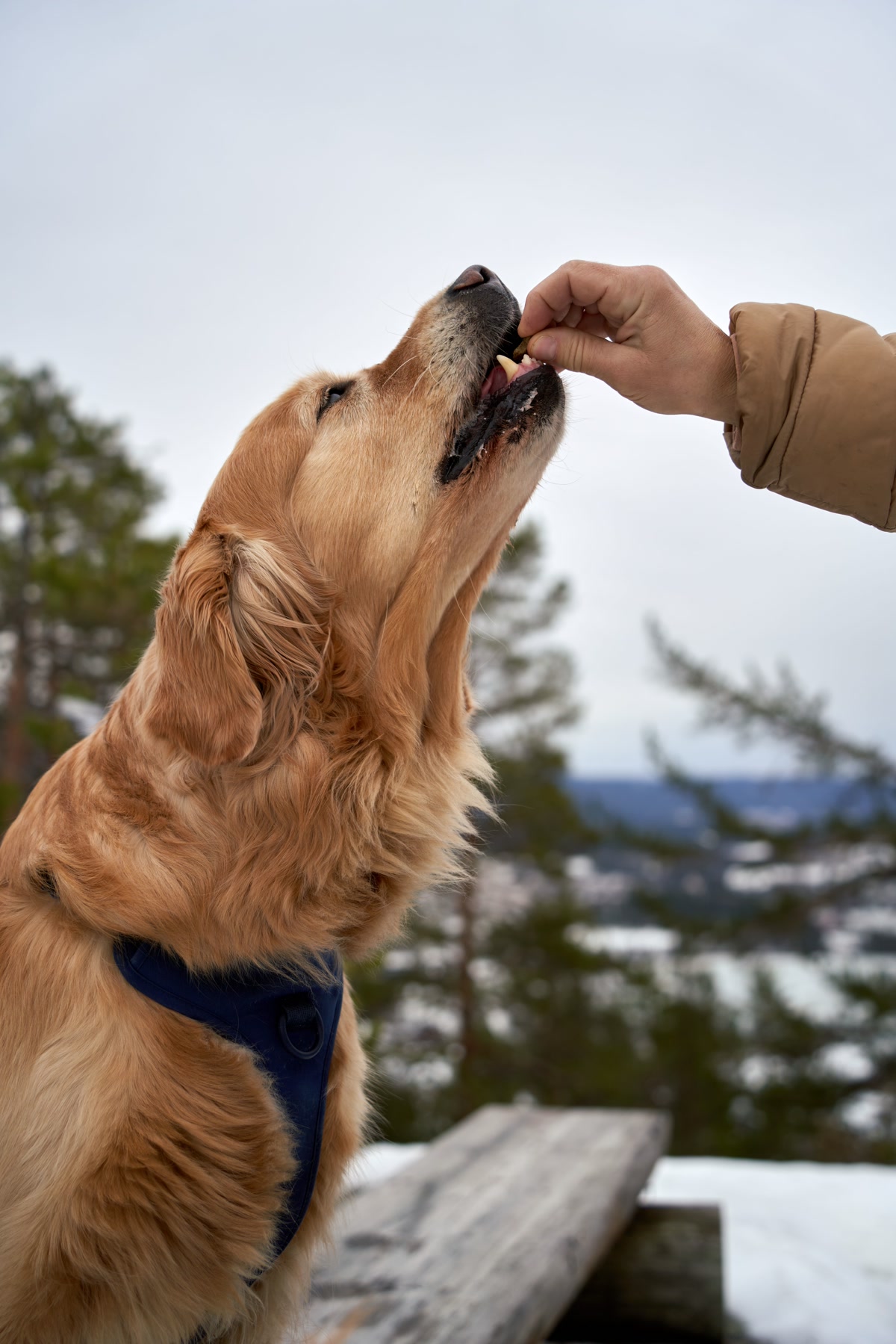
Reflective stitching catches some light but is barely visible at distances over 15 feet. Reflective trim — the wider, tape-like material used on the Flagline and Line 5.0 — is visible at 50+ feet with a headlamp. If you hike at dawn, dusk, or after dark, the difference matters. If you only hike in daylight, stitching is fine.
Water Resistance
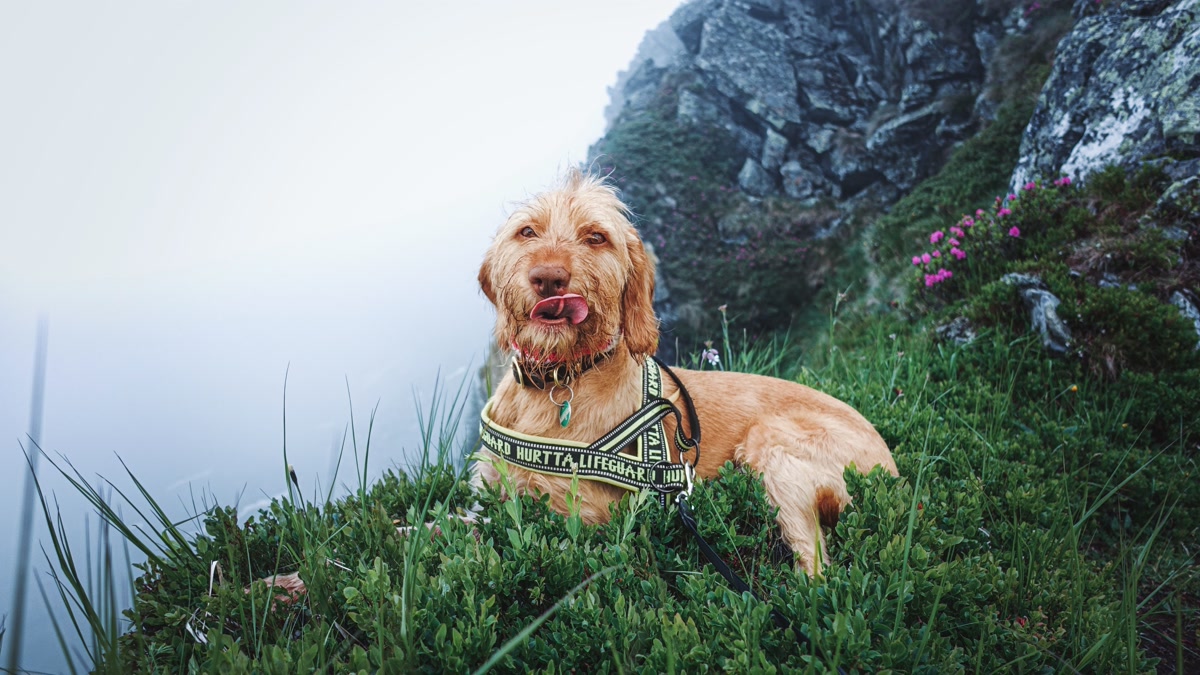
Closed-cell foam chest plates (Flagline, Front Range, Kurgo) do not absorb water. Open-cell foam and fabric padding (Rabbitgoo, Embark) will soak up stream water and stay wet for the rest of the hike. This matters in summer because a wet harness helps cool your dog, but it matters in shoulder season because a wet harness chills them. Know which type you are buying.
Machine Washability
Every harness in this list is hand-washable. None of them are designed for machine washing — the webbing and buckles will degrade. Hand wash with mild soap and warm water, then air dry. Do not put a hiking harness in the dryer.
When to Replace Your Harness
Hiking gear has a lifespan. Here are the signs it is time to retire a harness:
- Frayed webbing — If you can see the inner core of the strap, the tensile strength is compromised. Replace immediately.
- Buckle wear — If the buckle does not click securely or pops open under tension, it is done. This is the most common failure point on cheaper harnesses.
- Padding compression — If the foam chest plate has compressed to less than half its original thickness, it is no longer distributing pressure effectively.
- Reflective trim peeling — Once the reflective material starts peeling, it is only a matter of time before it is gone. For night hiking, replace it.
- Stitching unraveling — Any loose thread at a stress point (handle attachment, leash clip) is a failure waiting to happen.
A quality hiking harness should last 2 to 3 seasons of regular use, especially when paired with a good dog backpack for carrying trail essentials. The Ruffwear options tend to last longer — 3 to 4 seasons — because of the heavier-duty materials. The budget options will need replacing every 1 to 2 seasons if you hike weekly.
My Take
For most dog owners who hike, the Ruffwear Flagline is the harness to get. It is light, reflective, has a proper molded handle, and the closed-cell foam chest plate handles water and brush without degrading. If the price is too steep, the Front Range gives you 90 percent of the same features for about half the cost. And if you are just starting out and want to test the waters, the Embark Adventure at 25 to 35 dollars has every feature you need to get on the trail this weekend.
The harness that works is the one that fits your dog, fits your budget, and stays comfortable after six hours on the trail. Do not overthink it. Measure your dog, pick the option that matches your hiking style, and get out there.
GearHound is reader-supported. When you buy through links on this site, we may earn an affiliate commission at no extra cost to you.
⛺ Get Your Free Camping with Your Dog Checklist
Join our newsletter and get this free printable plus weekly tips.
Price Check
Prices verified via our product tracker. Updated Sep 27.
| Amazon.com: Ruffwear, Flagline Dog Body Harness, Lichen Gr | $69.99 | 4.5★ (3,211) |
| Amazon.com: Ruffwear, Flagline Dog Body Harness, Alpenglow | $69.99 | 4.5★ (3,211) |
| Amazon.com : Ruffwear, Front Range Dog Chest Harness, Basa | $59.99 | 4.6★ (19,045) |
| Amazon.com : Ruffwear, Front Range Dog Chest Harness, Rive | $59.99 | 4.6★ (19,045) |
| Amazon.com : Kurgo Journey Air Dog Harness, Blue, Large | | $37.49 | 4.4★ (3,029) |
| Amazon.com : Kurgo Journey Air Dog Harness, Black, Extra L | $37.97 | 4.4★ (3,029) |
| Amazon.com : Embark No Pull Dog Harness, Reflective Adjust | $36.99 | 4.5★ (10,747) |
| Amazon.com: Embark No Pull Dog Harness, Reflective Adjusta | $34.99 | 4.5★ (10,747) |
| Amazon.com : Non-stop Dogwear No Pull Dog Harness 5.0 - Pa | $54.99 | 4.4★ (170) |
| Amazon.com : Non-stop dogwear Freemotion Harness 5.0 Dog P | $99.99 | 4.3★ (571) |
| Amazon.com : rabbitgoo Dog Harness, No Pull for Large Dogs | $20.98 | 4.5★ (184,924) |
| Amazon.com : rabbitgoo Dog Harness, No Pull for Small Dogs | $22.98 | 4.5★ (184,924) |
As an Amazon Associate we earn from qualifying purchases.