
This article contains affiliate links. We may earn a commission from qualifying purchases.
Some content on this site is AI-assisted and reviewed by our editorial team.
# Best Dog Food Storage Containers 2026: Keep Kibble Fresh and Pests Out
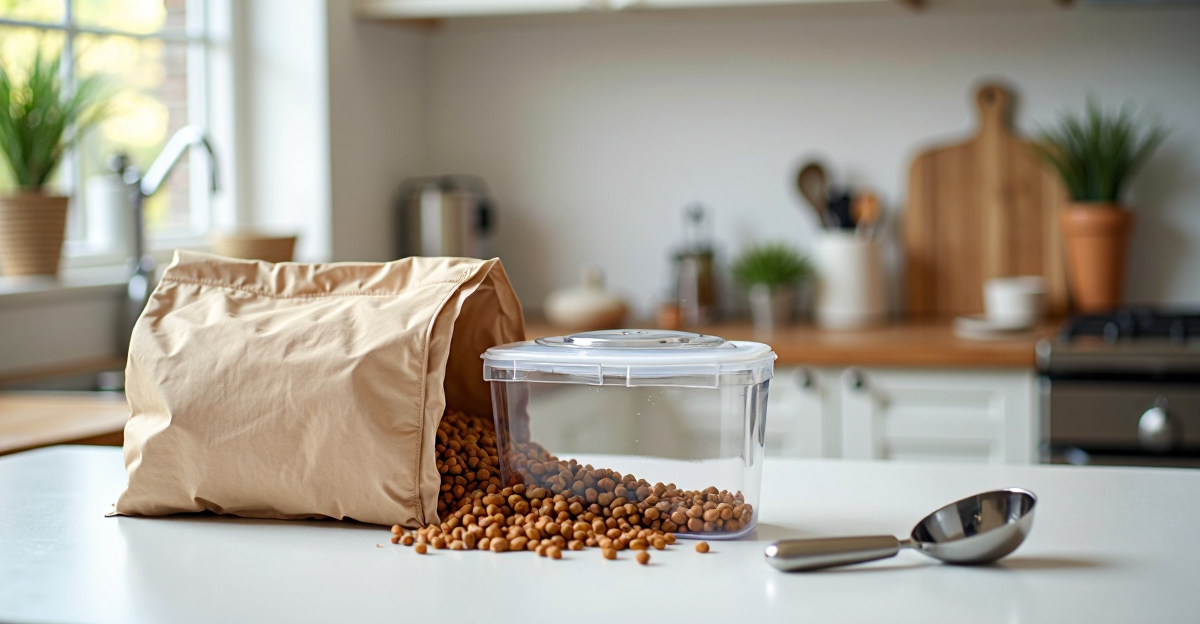
You buy good food for your dog. Then you leave it in the bag it came in, fold the top over, and wonder why it goes stale in a week. Or worse — you find out your dog figured out how to open that bag at 2 AM and helped themselves to a ten-dollar all-you-can-eat buffet.
A proper food storage container is one of those unglamorous purchases that saves you money, prevents waste, and keeps your dog healthier. Kibble goes rancid when exposed to air and moisture. Ants, mice, and your dog’s nose all find their way into poorly sealed bags. The right container solves all three problems.
We looked at the most popular dog food storage options and picked the ones that actually hold up — not just in lab tests, but in real homes with real dogs who will eat anything they can reach.
What Matters in a Dog Food Storage Container
Airtight seal. This is the whole point. If air gets in, kibble oxidizes and goes stale within days. Look for containers with rubber gaskets, snap-lock lids, or screw-top seals — not containers that just “close.”
Capacity vs. size. A 40-pound bag of kibble sounds like a lot until you try to fit it in a container rated for 40 pounds. Manufacturers measure capacity with the lid off and kibble piled high. Realistically, buy a container rated for 50–60 pounds to comfortably hold a 40-pound bag.
Pest resistance. Ants can get through remarkably small gaps. Mice can chew through thin plastic. A container that seals against air generally also seals against pests, but cheap containers with loose-fitting lids don’t do either.
Material safety. Food-grade plastic (BPA-free) or stainless steel. Avoid containers made from recycled materials of unknown origin — this is your dog’s food, not a garage tool bin.
Access convenience. Wheels, wide openings, and scoop-friendly designs matter more than you think. If getting food out is annoying, you’ll stop using the container.
—
my picks: Best Dog Food Storage Containers
### 1. Gamma2 Vittles Vault Outlaw — Best Overall
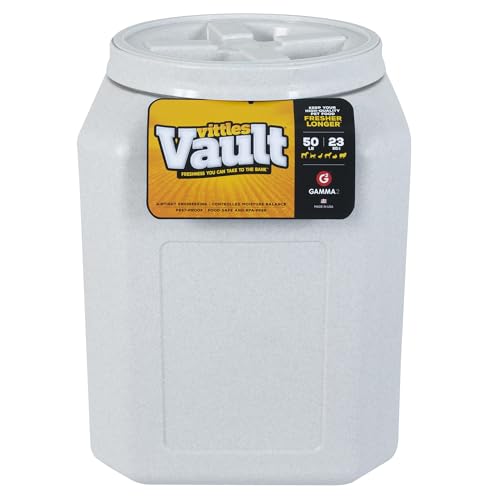
The Vittles Vault has been the standard in dog food storage for over a decade, and the Outlaw version is the best iteration yet. The key feature is the Gamma Seal lid — a screw-on, airtight lid with a spinning ring that creates a genuinely airtight seal. Not “push down hard and hope.” Actual, measurable airtightness.
Available in multiple sizes from 15 to 60+ pounds, in both stackable and standard shapes. Made from food-grade, BPA-free HDPE plastic. The wide opening makes it easy to pour a full bag of kibble in without spilling.
Pros: Genuinely airtight, pest-proof, durable, easy to clean, stackable options
Cons: Bulkier than some alternatives, lid can be stiff in cold temperatures
Best for: Most dog owners who want one container that handles everything.
—
### 2. Simple Human Brushed Stainless Steel Canister — Best for Small Spaces
Simplehuman Pet Food Storage Canister
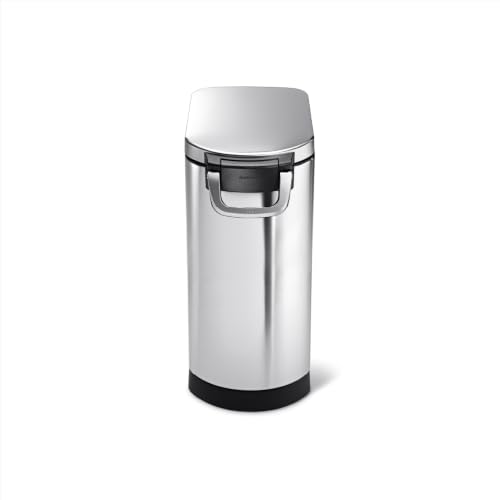
If you keep dog food in your kitchen and care about how it looks, this is the one. Brushed stainless steel exterior with a fingerprint-proof coating, a slide lid that opens with one foot tap, and a magnetic scoop that attaches to the inside of the lid so you never lose it.
The seal isn’t quite as airtight as the Vittles Vault — it’s a good seal, but it relies on a silicone gasket and gravity rather than a screw mechanism. For most kitchens this is plenty, but if you have serious pest problems, the Vittles Vault’s screw seal is more reliable.
Available in 15-liter and 25-liter sizes. The 25-liter holds roughly 20–25 pounds of kibble depending on piece size.
Pros: Beautiful, one-handed operation, magnetic scoop, fingerprint-proof
Cons: Expensive, not truly airtight, limited capacity
Best for: Small-bag buyers who store food in visible kitchen spaces.
—
### 3. IRIS USA Airtight Pet Food Container — Best Budget
IRIS USA Airtight Pet Food Container with Wheels
The IRIS container is what most people picture when they think “dog food bin” — a translucent plastic container with snap-lock latches and wheels. It’s affordable, it works, and it holds a lot.
The snap-lock latches create a decent seal. Not Vittles Vault-level airtight, but good enough for most homes. The wheels are a genuine convenience — a 40-pound container is awkward to drag across a floor. The translucent body lets you see how much food is left without opening it.
One real drawback: the latches can become brittle in extreme cold. If you store dog food in an unheated garage or shed in a cold climate, check the latches before each winter and replace the container if you see cracks.
Pros: Affordable, wheels, see-through body, multiple sizes, stackable
Cons: Latches can crack in cold, seal isn’t as tight as screw-top options
Best for: Budget-conscious owners who want function over premium features.
—
### 4. Buddeez Sandwich Pet Food Dispenser — Best for Easy Pouring
Buddeez 32 Quart Pet Food Dispenser
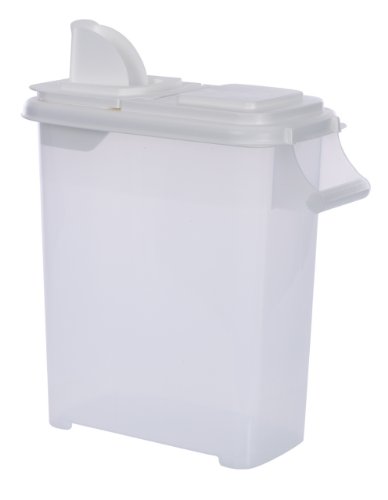
The Buddeez Sandwich gets its name from its shape — like a sandwich container scaled up to hold dog food. What makes it different is the pour spout. Instead of scooping kibble out, you tilt the container and pour. It sounds minor until you’re doing it twice a day for a decade.
The flip-top lid with a pour spout means you can fill a bowl one-handed while holding the leash in the other. The seal is a snap-lock system similar to the IRIS — good, not great. The shape makes it easy to slide into a pantry or next to a cabinet.
Available in multiple sizes. The 12-quart version holds about 8–10 pounds, and the 32-quart holds about 25 pounds.
Pros: Pour spout is genuinely convenient, slim profile, easy one-handed use
Cons: Smaller capacity, seal is adequate but not premium
Best for: People who want to pour, not scoop — especially good for smaller dogs or multi-pet homes with different foods.
—
### 5. OXO Good Grips POP Container — Best for Treats and Small Quantities
OXO Good Grips Pet POP Container
Not for your main kibble supply — the largest POP Container holds about 5 pounds. But for treats, supplements, freeze-dried food, or small-bag buyers, it’s unbeatable.
The push-button lid mechanism creates a genuinely airtight seal with one press. Press again to pop it open. The modular shapes stack neatly. BPA-free plastic with a fill line so you can track remaining food at a glance.
If you feed raw or freeze-dried food in small quantities, or if you need a clean way to store treats without them getting stale or absorbing pantry odors, this is the answer.
Pros: Perfect airtight seal, push-button operation, stackable, modular
Cons: Small capacity only, expensive per quart of storage
Best for: Treats, supplements, freeze-dried food, and small-bag storage.
—
How to Store Dog Food Properly (It’s Not Just the Container)
Even the best container won’t help if you use it wrong. Here’s what most people get wrong:
Don’t dump the whole bag in without the bag. The original bag has a fat barrier that keeps kibble from absorbing oxygen and moisture through the plastic. The best approach: put the entire bag inside the container. Cut the top off for easy access, but leave the kibble in its original packaging. This gives you double protection plus the bag has the lot number and expiration date if there’s ever a recall.
Store in a cool, dry place. Heat and humidity accelerate fat oxidation, which is what makes kibble go rancid. A garage that hits 100°F in summer is not ideal. A pantry or interior closet is.
Clean the container every time you finish a bag. Residual fat and crumbs oxidize and contaminate the fresh food you pour on top. Wash with hot soapy water, dry completely, then refill. This takes five minutes and extends food freshness by weeks.
Don’t mix old and new food in the same container. The old food’s degrading fats contaminate the new food. Finish one bag, clean, then add the next.
Check expiration dates. Most kibble is good for about a year from manufacture. Once opened, aim to use it within 6 weeks for maximum freshness.
—
Size Guide: How Big of a Container Do You Need?
Not sure what size to get? Here’s a practical guide:
- Small dog (under 25 lbs): 15–25 pound container. A 15-pound bag of small-breed kibble lasts 4–6 weeks.
- Medium dog (25–60 lbs): 30–40 pound container. You’re probably buying 25–30 pound bags.
- Large dog (60+ lbs): 50–60+ pound container. Most large-breed food comes in 30–40 pound bags, and you want room to spare.
- Multi-dog household: One container per food type. Don’t mix foods in one bin — different kibble sizes and fat contents means uneven freshness.
Rule of thumb: buy a container rated for 25–50% more than the bag size you typically purchase. Kibble doesn’t pack perfectly and you need room to close the lid without forcing it.
—
Apartment Storage Tips
If you’re in an apartment, you’re probably dealing with limited storage space. Check our apartment dog gear guide for the full breakdown, but for food storage specifically:
- Under-cabinet pull-out containers save floor space and keep food accessible
- A decorative canister on the counter works for treats and small quantities (the Simple Human or OXO are good looking enough for this)
- Stack containers vertically if you have multiple pets or food types
- A rolling container (like the IRIS with wheels) can slide into a closet or under a shelf when not in use
—
Which One Is Right for You
Dog food storage is not where you should cut corners. A 40-pound bag of premium kibble costs 50 to 80 dollars. When it goes stale or gets infested, that’s money wasted — and potentially a vet visit if your dog eats spoiled food. A good container costs 20 to 40 dollars and pays for itself the first time it saves a bag from going bad.
The Vittles Vault is our pick for most people because the screw-top seal actually works, the size range covers everything from Chihuahuas to Mastiffs, and it’s built to last for years. But the right container depends on your space, your budget, and how you feed — any of the five above will do the job better than leaving food in the bag.
For more gear that saves you money over time, see our best products under 25 dollars and our guide to dog toys that actually last.
—
n
GearHound is reader-supported. When you buy through links on this site, we may earn an affiliate commission at no extra cost to you.
⛺ Get Your Free Camping with Your Dog Checklist
Join our newsletter and get this free printable plus weekly tips.
Price Check
Prices verified via our product tracker. Updated Sep 27.
| Pet Supplies : Gamma2 Vittles Vault Airtight Pet Food Stor | $44.99 | 4.7★ (110,637) |
| Pet Supplies : simplehuman 35 Liter, 40 lb / 18.1 kg X-Lar | $149.99 | 4.7★ (8,395) |
| Amazon.com: Schwinn Girls' Codex Helmet : Sports & Outdoor | $25.00 | 4.3★ (269) |
| Amazon.com : Buddeez Airtight Pet Food Storage Container, | $50.50 | 4.7★ (3,332) |
| Amazon.com: OXO Good Grips Pet POP Container – 6.0 Qt/5.7 | $24.99 | 4.6★ (4,673) |
As an Amazon Associate we earn from qualifying purchases.