This article contains affiliate links. We may earn a commission from qualifying purchases.
Some content on this site is AI-assisted and reviewed by our editorial team.
Every winter I watch the same scene at trailheads: engines idling for heat while somebody waits in the car, or an EV driver watching range tick down because the cabin heater is pulling three kilowatts. Both pay — in fuel or in battery — to warm air that keeps drifting away. A heated 12 volt blanket flips that math: four amps at 12 volts is about 48 watts, less than 2% of what an EV cabin heater burns, and a couple hours of it won’t doom a healthy starter battery. The trick is picking one with the right cord, the right timer, and honest heat. Here are the four I’d plug in this winter.
Four blankets, four different jobs — here’s how they shake out.
Sino Salected 12V/24V Heated Car Blanket — The Dual-Voltage Two-Person Pick
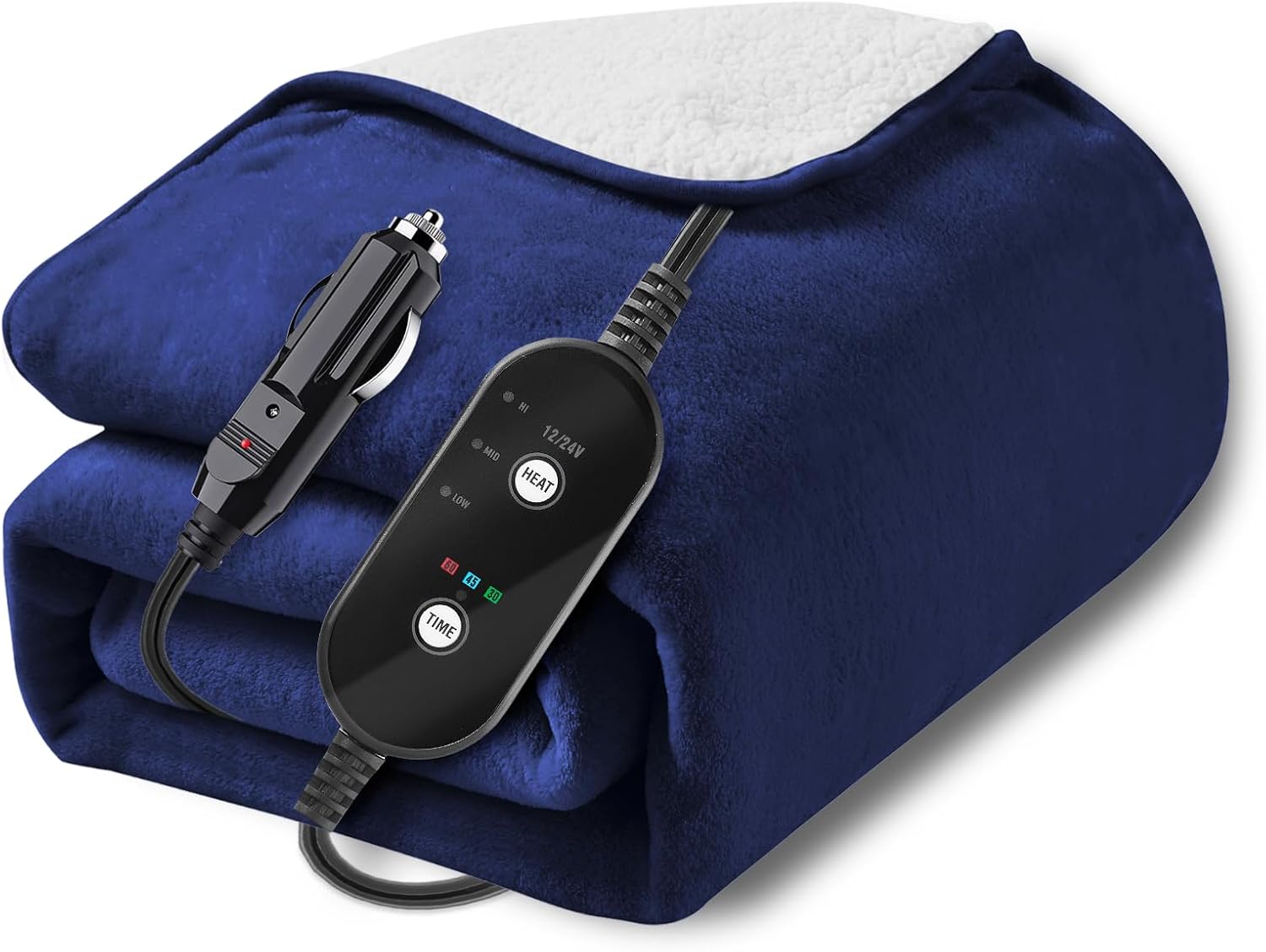
The Sino Salected 12V/24V heated car blanket is the one I’d hand a semi driver — it’s the only blanket here that plugs into both 12-volt and 24-volt outlets, and older semis and work vans run 24-volt systems that cook a 12-volt-only element. Around $40 gets a 60×44-inch spread of flannel over Sherpa — genuinely two-person coverage across a truck bench seat. The stack also earns its keep unplugged, holding enough dead air to work as a picnic blanket with the power cut.
The honest con: the cord is the stiffest here, and it gets worse in real cold — below about 15°F it fights you when you drape it across a seat. And the heat is gentle — more a dog leaning against your legs than a heating pad.
My take: the only pick here that belongs in a 24-volt truck, and the warmest of the four before you plug it in.
Sealy 12V Heated Car Blanket with USB — The Third-Row Cord King
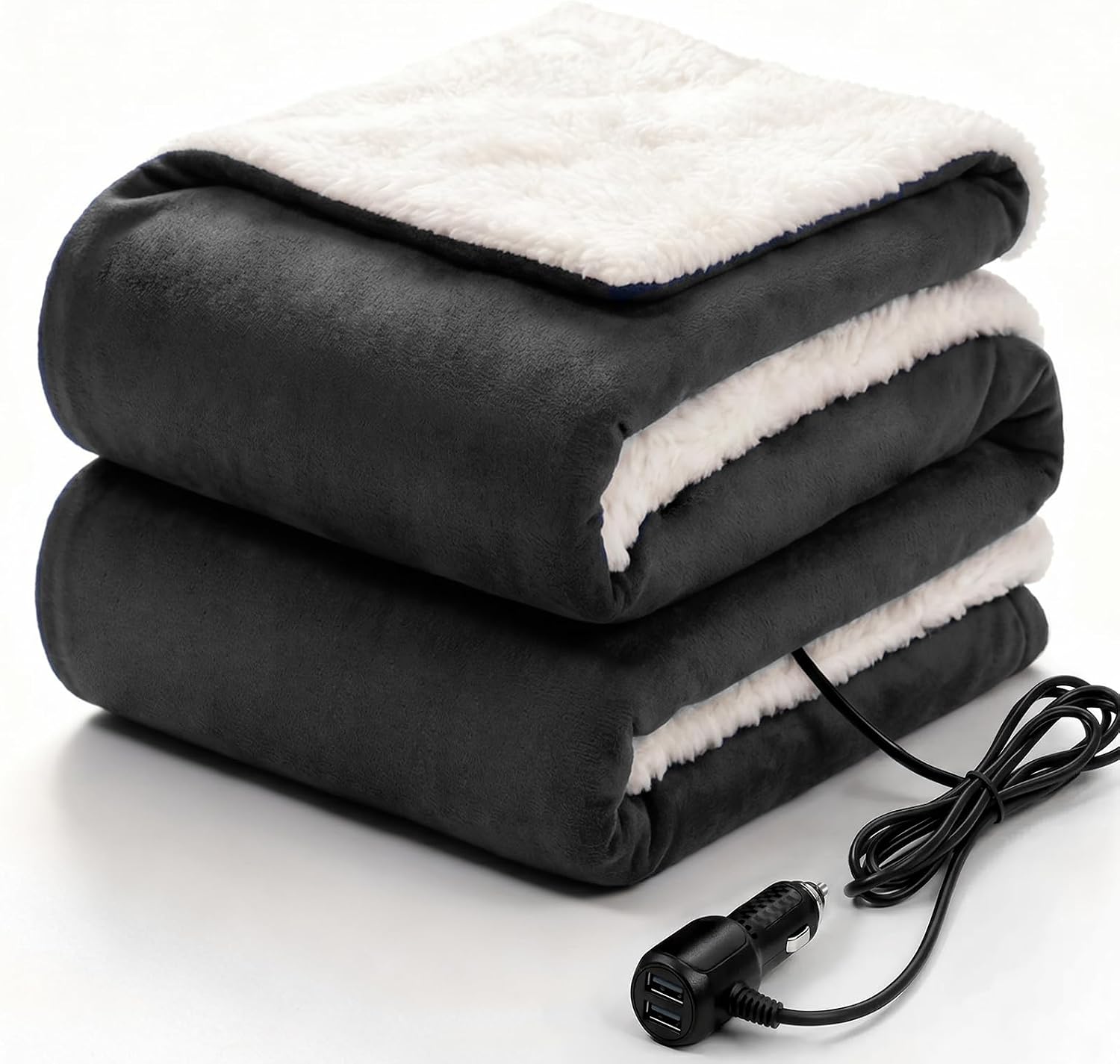
The Sealy 12V heated car blanket with USB solves the problem nobody thinks about until a kid in the back seat is cold: reach. The 85-inch cord is why this one wins the minivan category — dash outlet to third row with slack to spare, no unplugging required. At roughly $35, the 59×43-inch blanket also carries two USB ports on the control housing — the difference between a warm kid and a warm kid with a dead tablet.
The spec that sold me is the 4-hour auto-off — the longest in this class. That matters overnight in a truck camper or at a drive-in, where a 45-minute timer means waking every hour to hit the switch. Four hours at 4 amps is only about 16 amp-hours out of a 50Ah battery, and it cycles off before you’re asleep enough to forget.
The honest con: the three heat settings cycle to nearly the same warmth. You’ll pick one and never touch the button again.
My take: if anybody in your life rides in a third row, this is the blanket — the cord alone justifies it.
Sojoy 12V Fleece Heated Blanket — The Best-Price Full-Body Option
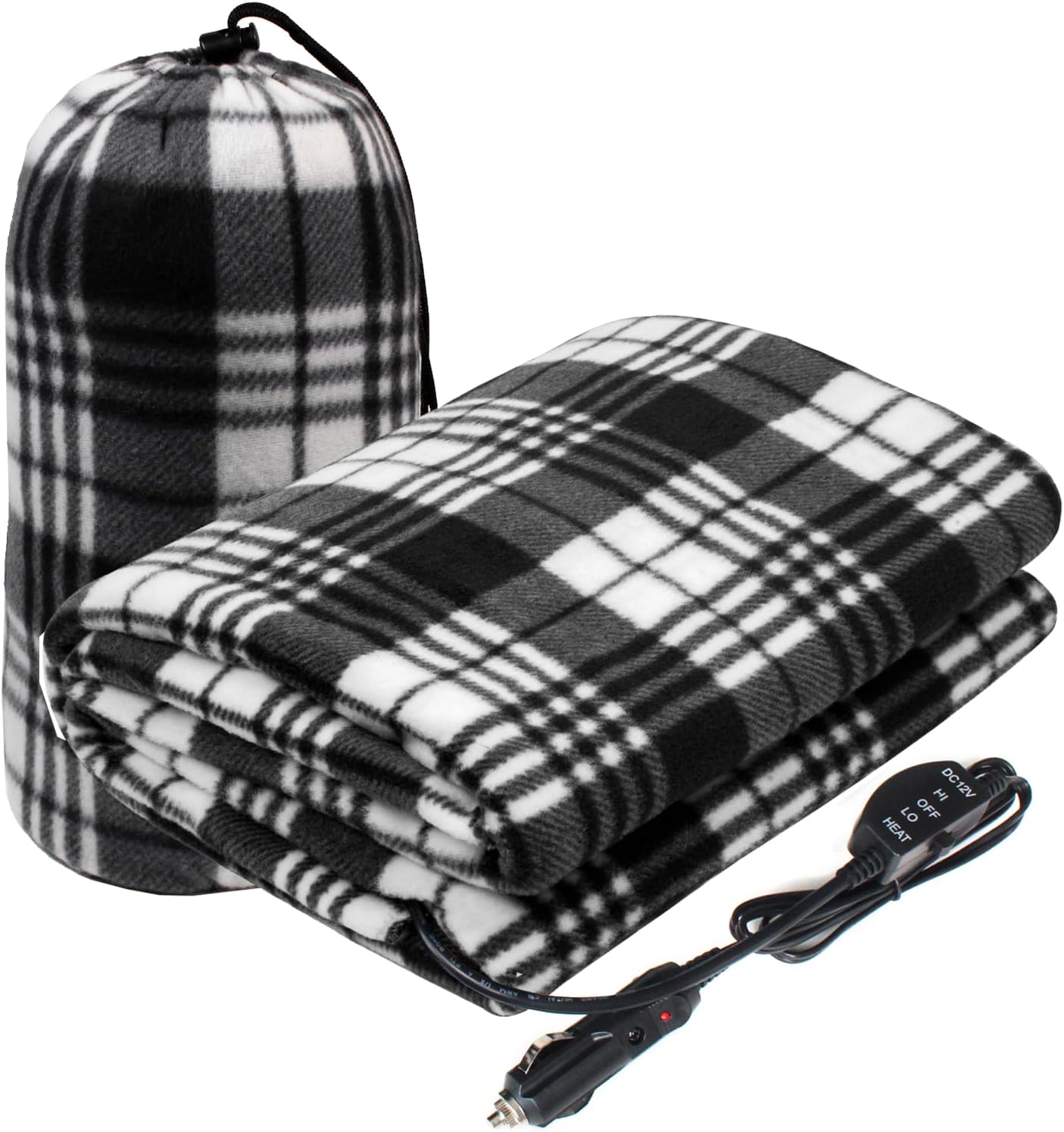
The Sojoy 12V fleece heated blanket is the value play at about $30, and it doesn’t give up size to get there. At 60×40 inches it’s the longest blanket here — boots to shoulders for most adults, exactly what you want sleeping in the back of an SUV. The 72-inch cord reaches dash to cargo area in a midsize rig, though it’s tight in a full-length van. The fleece is the softest of the four and stuffs down to live in a door pocket all season — where a January blanket belongs anyway.
The honest con, and it’s the big one: the heat rise is measured, not mighty. Expect 6 to 9 degrees Fahrenheit over cabin temperature — it takes the edge off a cold night, it does not bake you. If you want heat radiating at your back, spend the extra $10 on the Sino Salected.
My take: the cheapest blanket here that still covers a whole adult, as long as you respect that it’s an edge-taker-offer, not a furnace.
Stalwart Electric Heated Car Blanket — The Emergency-Kit Stash
The Stalwart electric heated car blanket is the one I review from the glovebox, because that’s where it lives. At about $25 it’s the cheapest stocked option, and the argument is availability: it’s thin, it folds to the size of a paperback stack, and it belongs in the winter kit of every vehicle you own. The 96-inch cord is the longest here — eight feet, dash to tailgate — and the draw sits around 4 amps like everything else. What you’re buying is insurance, not comfort: 50×36 inches covers a kid’s legs or one adult’s lap, and a single heat switch means you’re warm-ish or you’re off.
The honest con: expect to replace it yearly if it’s actually in rotation, because the fleece pills after a season and the single switch gives no middle ground on warmth.
My take: buy two for the price of one premium blanket and stash one in every truck — it’s the twenty-five-dollar insurance policy you’ll thank yourself for at the next flat tire in a snow squall.
Don’t pay shipping on warmth. Everything on this page is under $40, but winter delivery windows get ugly — the blanket you order tonight needs to be in the truck before the next cold snap, not in a warehouse queue. If you’re not a Prime member yet, start a free 30-day Prime trial here for free two-day shipping on all four, plus free returns if the cord doesn’t reach.
Features That Actually Matter (And Ones That Don’t)
Amp draw is the whole spec sheet. Every blanket here pulls roughly 4 amps at 12 volts — about 48 watts, a rounding error next to the 1,500-watt space heater you can’t run off a car outlet without melting wiring. One hour engine-off costs about 4 amp-hours, roughly 8% of a 50Ah starter battery; two hours is 16%. Past that, you’re borrowing spring starts from your battery.

The auto-off timer is a battery saver, not a convenience. A 45-minute cycle costs about 3 amp-hours — 6% of a 50Ah battery — then stops, even if you fall asleep in the truck bed. The Sealy’s 4-hour timer is the outlier, built for people sleeping in the vehicle; the 30-to-60-minute timers on the rest are for passengers. Match the timer to the job or the math runs away from you.
Cord length decides where the blanket can live. Measure first: dash outlet to second row is about 60 inches, and to a third row or cargo area you want 85-plus. The Stalwart’s 96-inch cord and the Sealy’s 85 are the only two that reach the way-back in a full-size rig.
Unplugged warmth counts double. The element only runs while the vehicle feeds it power — the rest of the trip, that blanket is just fabric. The Sino Salected’s flannel-and-Sherpa stack is the only one here I’d pick as a blanket even with the cord coiled.
Ignore heat-setting counts and fabric buzzwords. Three settings that cycle to the same warmth (Sealy) and “instant heat” marketing tell you nothing. What matters is the measured rise: most of these deliver a gentle 6-to-9-degree bump, and that’s by design, not defect.
On value: the spread runs $25 to $40, and the premium buys real things — dual-voltage compatibility and two-person coverage on the Sino Salected, the third-row cord and USB ports on the Sealy. For most buyers the middle is the sweet spot: the $30 Sojoy covers a whole adult; if it’s mainly for minivan kids, the extra $5 for the Sealy buys the cord and timer. Then stash the $25 Stalwart in the truck you drive least — that’s the truck that breaks down.
While you’re winterizing the kit, I’ve covered the rest of the cold-weather stack: propane tent heaters that take the edge off for tent nights when no blanket is enough, thermal cookers that finish stew on the drive home, and portable gas grills for cold-weather campsites when the fire ring is buried. Keep reading and build the kit before the first real cold snap.
GearHound is reader-supported. As an Amazon Associate, I earn from qualifying purchases. That means if you buy through one of the links above, I get a small commission at no extra cost to you. I only recommend gear I’d actually carry into the field.
⛺ Get Your Free Camping with Your Dog Checklist
Join our newsletter and get this free printable plus weekly tips.
Frequently Asked Questions
Will a 12-volt heated blanket drain a car battery?
It will if you leave it running with the engine off long enough — but “long enough” is longer than most people fear. A typical blanket draws about 4 amps, which works out to roughly 4 amp-hours per hour — about 8% of a 50Ah starter battery every hour it runs. An hour at the trailhead is fine; leaving it plugged in overnight in a parked car is how you end up with a dead battery in the coldest week of the year, exactly when a cold battery has the least cranking power to spare. The auto-off timers on these blankets exist precisely because people forget. If you’re sleeping in the vehicle, run the engine for fifteen minutes every couple of hours, or run the blanket off a portable power station and save the starter battery for starting.
How many amps does a 12-volt heated blanket draw?
Most pull 3.5 to 5 amps at 12 volts — about 40 to 60 watts, roughly what an old incandescent light bulb burns. The blankets in this roundup cluster around 4 amps. That’s deliberately gentle: a 1,500-watt space heater would demand 125 amps at 12 volts, far more than a cigarette-lighter outlet can safely carry, so 12-volt heat will always be “take the edge off” heat, not “warm the whole cabin” heat. For battery math, figure 4 amp-hours per hour of use against your battery’s capacity — a 50Ah battery gives you roughly six hours of runtime before you’re into the danger zone, and less when it’s cold.
Can you run a heated car blanket off a portable power station in a tent?
Yes — as long as the station has a 12-volt DC outlet, not just AC and USB ports. The blanket’s plug needs that cigarette-lighter-style socket, and a 5-volt USB port can’t drive a 12-volt heating element. Check the specs for a 12V output rated at least 5 amps. At about 4 amps (48 watts), a 300Wh station runs one of these blankets for roughly five hours of heat with zero drain on your car’s starter battery and no carbon-monoxide risk in a sealed tent — which is why it’s my preferred way to add warmth overnight.
Liked this guide? Get the next one in your inbox — the camp packing checklist is free too.
✓ You're in — check your inbox.
No spam. Unsubscribe anytime. We never share your email.
Prices move fast. Start your Amazon trip from our Shop & Support page and your purchases support GearHound at no extra cost to you.